Revisiting Linear Equations: A Simple Explanation
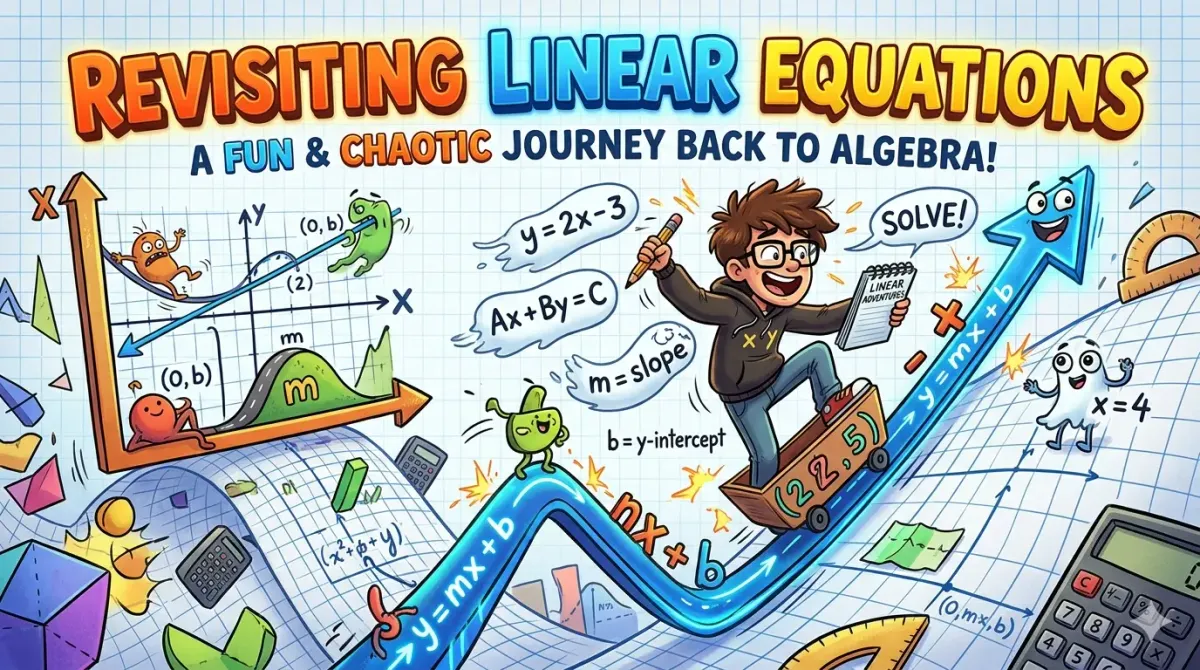
Today I want to share something interesting and fundamental in mathematics: linear equations.
Most of us learned this topic in school. But when we revisit it later, we usually understand it with a broader and deeper perspective. So let’s walk through the basics again in a simple way.
What Is an Equation?
An equation is simply a mathematical statement that shows two expressions are equal.
For example:
2x + 3 = 7
Here the left side and the right side are equal.
A solution of an equation is the value of the variable that makes the equation true.
Example:
2x + 3 = 7
Solve for x:
2x = 7 - 3
2x = 4
x = 2
So x = 2 is the solution because it satisfies the equation.
What Is a Linear Equation?
A linear equation is an equation where:
- Each variable appears only to the first power
- Variables are not multiplied together
Example:
2x + 3y = 7
In geometry, the graph of a linear equation (with two variables) is always a straight line.
Standard Form of a Linear Equation
The standard form of a linear equation with n variables is:
a₁x₁ + a₂x₂ + a₃x₃ + ... + aₙxₙ = b
Where:
- a₁, a₂, …, aₙ → coefficients (numbers multiplying the variables)
- x₁, x₂, …, xₙ → variables or unknowns
- b → constant value
Example:
2x + 3y = 6
Here:
- x, y → variables
- 2, 3 → coefficients
- 6 → constant
A solution is any pair of values for x and y that satisfies the equation.
Example solutions:
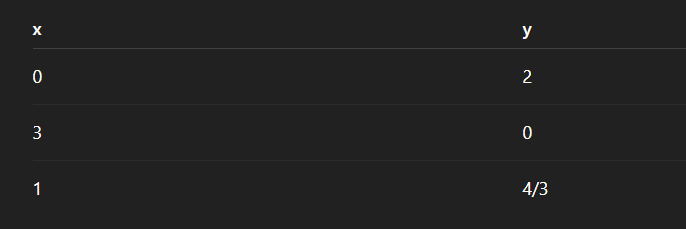
Each pair satisfies the equation:
2x + 3y = 6
Parametric Solutions for Linear Equations
Sometimes a linear equation has more variables than constraints. In that case, there are infinitely many solutions.
To represent them, we use parameters.
A parameter is a variable that can take any real value.
Example:
x + y = 5
Solve for y:
y = 5 - x
Let:
x = t
(where t is any real number)
Then:
y = 5 - t
So the parametric solution becomes:
(x, y) = (t, 5 - t)
This represents all possible solutions of the equation.
Graphical View of Linear Equations
The geometric representation of a linear equation depends on the number of variables.
so if we have 1 variable it means its only describe a one point that means grapical representation of 1 variable equation is just a point. if we have two variable that descripe set of points which is can represent as a line. as like that following table contain number of variables and its representations.

For example:
x + y = 5
represents a straight line in the coordinate plane.
Linear Systems
A linear system is a collection of two or more linear equations.
Example:
x + y = 3
x - y = 5
The goal is to find values for the variables that satisfy all equations simultaneously.
Solve the system:
Add both equations:
(x + y) + (x - y) = 3 + 52x = 8
x = 4
Substitute into the first equation:
4 + y = 3
y = -1
So the solution is:
x = 4
y = -1
Types of Solutions in Linear Systems
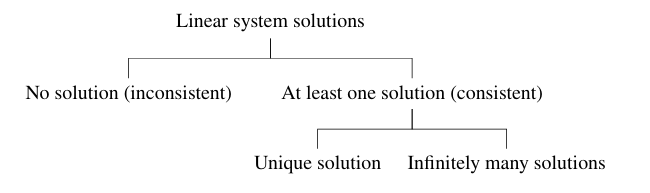
Also based on the solutions that we have, we can divide linear system solutions into main two types: consistent and inconsistent. And this consistent one into two types as have a one solution or infinite solutions. Inconsistent means there is no solution that satisfies all the equations. So here, think about the graphical representation of these equations in two-dimensional space. We previously discussed that if there is a solution, the lines should cross each other or the lines should be the same.
So when does it have no solution? Exactly when those lines are parallel. Think about lines that are not parallel — at some point they must cross, right? The lines that never cross are parallel.
And can there be multiple solutions? No, right? Because these are lines, and they cannot cross twice without changing their linearity. So there are only three possible solution forms: no solution, one solution, or infinite solutions. Infinite solutions appear when all the equations describe the same line.
1. No Solution (Inconsistent System)
An inconsistent system has no solution.
This happens when the equations represent parallel lines that never intersect.
Example:
x - 2y = 5
2x - 4y = 7
Multiply the first equation by 2:
2x - 4y = 10
Now compare:
2x - 4y = 10
2x - 4y = 7
These cannot both be true at the same time.
So the system has no solution.
Graphically:
Two parallel lines.
2. One Solution (Consistent Independent System)
A system has one solution when the lines intersect at exactly one point.
Example:
x - y = 5
x + y = 3
Add the equations:
2x = 8
x = 4
Substitute back:
4 + y = 3
y = -1
So the solution is:
(4 , -1)
Graphically:
Two lines intersect at one point.
3. Infinite Solutions (Consistent Dependent System)
A system has infinitely many solutions when both equations represent the same line.
Example:
x - y = 5
2x - 2y = 10
Notice:
2x - 2y = 10
is just 2 × (x — y = 5).
Both equations describe the same line.
Therefore the system has infinitely many solutions.